 Uncx
Uncx liquidity locking - locked assets and withdrawal limits
Uncx liquidity locking prevents early withdrawal by holding supported LP tokens or liquidity positions in a smart contract until the chosen unlock date. LP means liquidity provider; these assets represent participation in a pool. The restriction covers the assets in that lock, so its pool, committed amount or position, and expiry matter. A wallet approval alone doesn't establish that custody has changed. The confirmed lock record shows the commitment that others can inspect. Fee collection, where the selected locker supports it, remains separate from withdrawing the position. A time lock also leaves token-contract risks and market-price changes outside its protection.
LP tokens and position NFTs
V2 lockers hold LP tokens, while supported V3 and V4 lockers hold an NFT representing a liquidity position. An NFT is a non-fungible token that identifies that position. These representations determine what the locker receives and what the owner can later withdraw. A token balance and a position NFT therefore require their respective supported locking tools.
Locker V3.1's lock function converts the position to full range. The V3 setup interface offers a choice between retaining a position's range and converting it to full range. The asset identifier belongs alongside the network and pool details. A matching project name alone doesn't establish that a record covers the intended position.
The pool share covered by a lock
A lock applies to the LP tokens or position that the owner deposits. It doesn't automatically commit every liquidity position in the same pool.
An LP-token holder chooses the quantity to commit. Tokens outside that commitment remain outside its withdrawal restriction. With a position NFT, the record identifies a particular position. Another provider may hold a separate position in the same pool without locking it. Read the committed asset or quantity alongside the pool details before treating a lock as evidence about total pool liquidity.
Locked liquidity cannot be withdrawn before the lock's unlock date. That restriction addresses removal through the locked position. It doesn't remove minting powers or other permissions from the project's token contract. Token vesting separately controls allocated token releases; an LP lock doesn't create those recipient schedules.
Network, pool, and date selection
Compatibility depends on the network, pool, and automated market maker version. Ethereum and other supported EVM networks have separate availability from Solana lockers. EVM means Ethereum Virtual Machine. Support for a chain doesn't establish support for every pool implementation on that chain. The selected locker must accept the actual LP tokens or position that the holder wants to commit.
The unlock date defines the intended withdrawal boundary. V3 setup also offers a Lock Eternally setting that locks liquidity forever. Choose the duration before authorizing the commitment because later management controls don't provide a way to shorten it.
Approval and the change in custody
Asset approval authorizes the locker to handle the required token or position. The lock action creates the commitment under its selected terms. The V3 creation flow distinguishes approval from the subsequent NFT-locking action. An approval confirmation alone therefore doesn't establish a completed lock. The onchain lock record identifies the committed position, owner, and unlock date, making custody and permission separately observable.
A public lock record and its associated blockchain transaction allow inspection beyond a promotional claim. A shareable image summarizes the details; the live record also reflects later management changes. Extending the date or transferring control can make an older image incomplete.
The charges attached to each action
Locker costs depend on the network, version, and selected fee configuration. The fee basis changes with the action, so creation and later collection need separate treatment.
Service charges
Lock creation
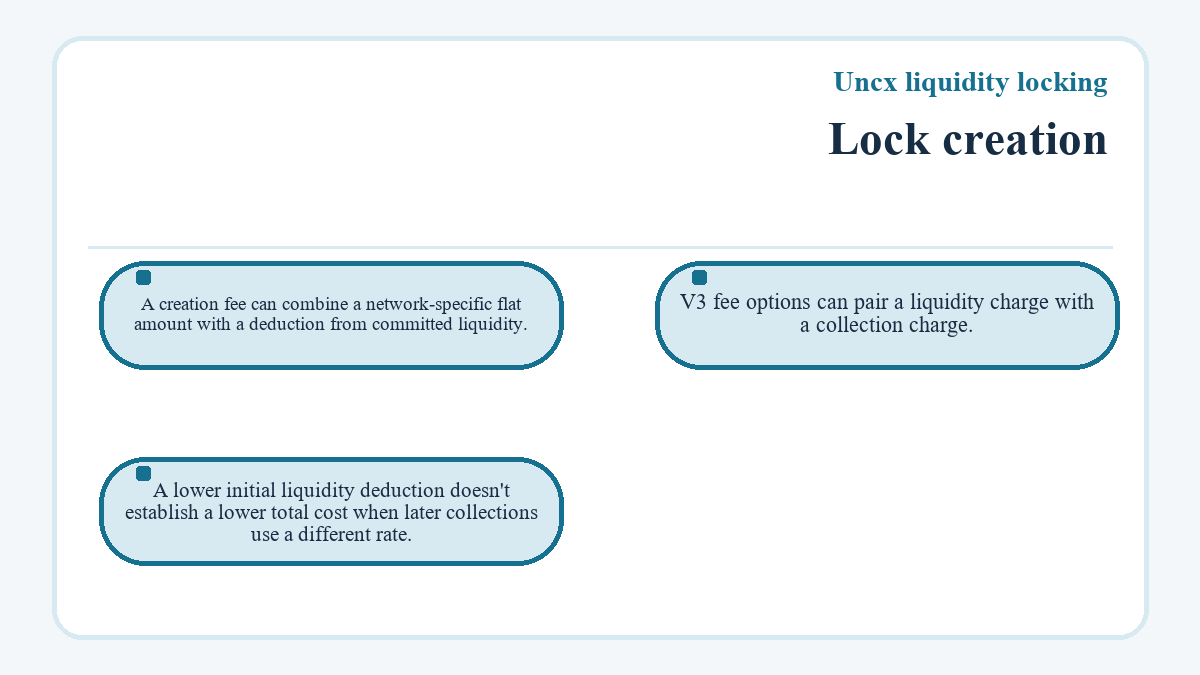
A creation fee can combine a network-specific flat amount with a deduction from committed liquidity. V3 fee options can pair a liquidity charge with a collection charge. A lower initial liquidity deduction doesn't establish a lower total cost when later collections use a different rate.
Trading-fee collection
Where the locker charges for collection, the charge applies to collected trading fees under that lock's configuration. Future collection costs also depend on fees actually accruing to the position.
Network gas
The network charges gas separately from locker service fees. A native-token gas balance remains necessary even when a particular management action has no service charge.
Fee collection without releasing the position
Supported position lockers allow trading-fee collection during the lock. The locked position remains committed while an authorized collector claims accrued fees. Those fees remain separate from the liquidity that the withdrawal restriction protects. A staking or farming pool distributes a funded reward budget under its own terms; locking an LP position doesn't create that reward program.
A collection control doesn't establish how much the position has earned. The fee configuration determines the service deduction, while actual pool activity generates trading fees. The unlock date alone doesn't specify a yield or payout amount.
A completed lock matched to the held asset
In this hypothetical case, a holder has a supported V3 liquidity-position NFT on a compatible network, chooses an unlock date, and selects an available fee option. The holder wants the public record to identify the resulting locked position and the intended date.
An LP-token locker accepts supported LP tokens; a position locker accepts the supported NFT. Both implement withdrawal commitments, but only the position locker matches the asset in this case. The holder selects that option and reviews its range treatment and costs before approving and locking. The relevant inputs include the network, locker version, committed liquidity, and fee configuration. Any later collection charge uses the fees collected, keeping that cost separate from the creation deduction.
After the lock transaction confirms, the record identifies the resulting locked position, owner, and chosen unlock date. That match establishes creation of the intended lock. A successful approval transaction without a matching lock record establishes permission only. Neither observation establishes a future token price or an eventual fee payout.
Expiry and the limits of later changes
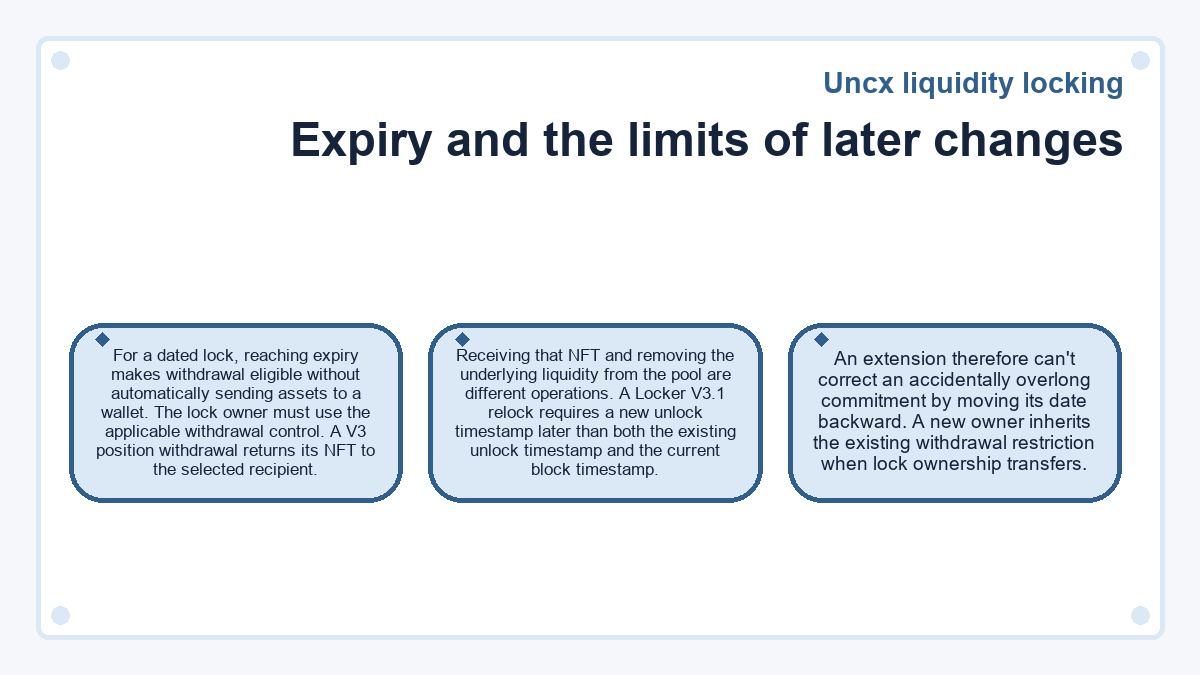
For a dated lock, reaching expiry makes withdrawal eligible without automatically sending assets to a wallet. The lock owner must use the applicable withdrawal control. A V3 position withdrawal returns its NFT to the selected recipient. Receiving that NFT and removing the underlying liquidity from the pool are different operations.
A Locker V3.1 relock requires a new unlock timestamp later than both the existing unlock timestamp and the current block timestamp. An extension therefore can't correct an accidentally overlong commitment by moving its date backward. A new owner inherits the existing withdrawal restriction when lock ownership transfers.
Uncx liquidity locking questions, answered
Can a V2 lock receive additional LP tokens without a new lock?
The V2 Increment control adds LP tokens to an existing lock. Its fee schedule treats incremental locking as a chargeable action, so increasing the commitment has its own cost. The added quantity belongs to that particular lock; topping it up doesn't establish that any separate pool position is locked.
Does splitting a V2 lock create an earlier withdrawal date?
Splitting a V2 lock creates two locks without changing the unlock date. The division changes how the locked LP tokens sit across the resulting locks, while both keep the original time boundary. V2 split-lock service charges use the network's standard flat fee, with network gas charged separately.
Who can trigger collection for a V3 liquidity lock?
The V3 lock owner and a configured additional collector can initiate fee collection. The additional collector's permission covers collection; it doesn't itself grant ownership of the locked NFT. The wallet that receives collected fees has a separate role from the address that can trigger collection. Neither role changes the unlock date.
Where does dust from a V3 full-range conversion go?
For V3 locking routes that convert a position to full range, the configured dust receiver receives residual token amounts from that conversion. The dust receiver setting concerns conversion leftovers, while the fee collector setting concerns trading-fee receipts. These settings describe the disposition of different amounts, not permission to withdraw the locked position early.
Can the V3 lock owner differ from the wallet creating the lock?
V3 setup includes an External Owner field for assigning the lock to a different address. The connected wallet supplies the default owner when no external owner replaces it. The owner controls the lock, so confirm that address before creation. Assigning a fee recipient doesn't make that recipient the lock owner.
Are V2 and V3 relocking service fees identical?
V2 relocking charges 1% of the relocked LP amount, with no additional flat service fee. V3 relocking has no service charge. Network gas remains separate in both cases, so a free relocking service doesn't make the transaction costless.